Substrate preparation:
The substrate should be clean, dry, free of dust, dirt, oil, grease, paint residue, and other contaminants (especially release agents) that may prevent the product from adhering properly to the substrate. Immediately before applying the product, porous substrates and absorbent building materials (including brick, concrete blocks, plaster, concrete, wood, and plasterboard) should be lightly moistened with water. This treatment improves adhesion and accelerates the curing of the spray insulation. Smooth and non-absorbent substrates (including metal, glass, and plastics) should not be moistened before application.
Product preparation:
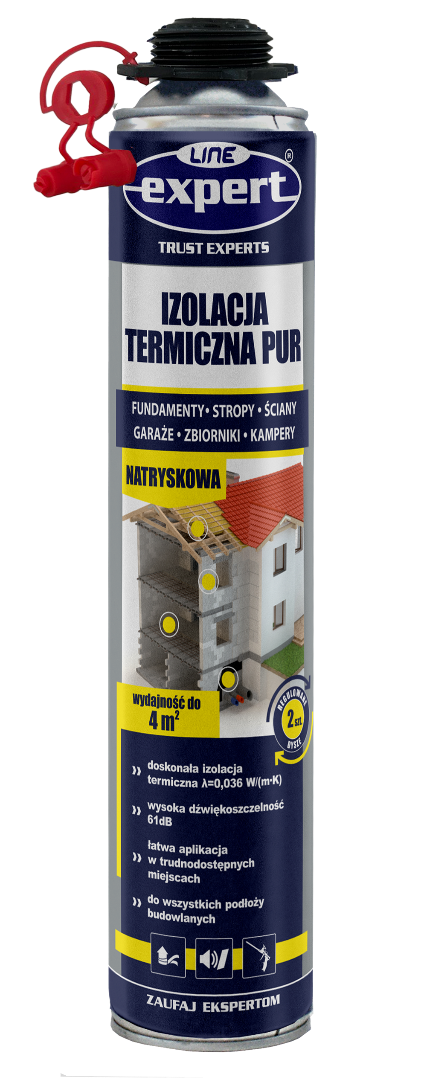
Before use, warm the can of product that is too cold to room temperature (e.g., by immersing it in warm water). Before use, shake the can vigorously (for approximately 30 seconds) to thoroughly mix the ingredients. Screw the can onto the application gun. Attach the spray nozzle to the barrel of the application gun and press firmly until you hear a click. The kit comes with two types of applicators mounted on the application gun: a straight one and an optional angled one (asymmetrical for insulation, e.g., ceilings).
Foam application:
General recommendations:
Apply the insulation in an upside-down working position. Adjust the spray flow by adjusting the needle or pressing the application gun trigger. If the application is interrupted for more than 15 minutes, secure the application gun and leave the can screwed on for the next use. After finishing work, clean the gun of any remaining insulation foam using the Expert Line PU Foam Cleaner. After cleaning the application gun and screwing on a new can of product, remove any remaining cleaning fluid by briefly spraying it into a container or onto another surface.
Working with spray insulation:
Always wear safety glasses and gloves when working, and ensure adequate ventilation at the application site. Do not use the product near open flames, heat sources, etc. Apply the foam to the substrate at a distance of 20-40 cm from the surface. The distance from the substrate determines the width of the application stream; the greater the distance from the substrate, the wider the stream (and therefore the thinner the single-use insulation layer). Immediately after application, the foam increases in volume by 20 to 80% (depending on conditions and the thickness of the sprayed layer). Do not apply a layer thicker than 3 cm at a time; to achieve the target insulation thickness, the product should be applied in layers. After applying each layer, moisten the applied foam and wait approximately 15-20 minutes before applying the next layer. Check that the previously applied layer is not wet from excess moisture and is not sticky. During prolonged application or after a break of more than 15 minutes, shake the can again to mix the ingredients. If the foam flow is uneven, check the cleanliness and unobstructedness of the application nozzle and/or the application gun itself. If the nozzle is clogged, clean the dispensing device. After completing the work and the material has cured, protect the insulation layer from UV radiation (e.g., by covering it with paint or protecting it with panels/plasterboard).